
chooseCards
Sent when the player must pick cards from a presented set - discard to hand size, choose cards to sacrifice, pick targets from a revealed pile, and similar. The engine sends the candidate cards inline so the client can render them without consulting game state.
Arguments
Section titled “Arguments”input.type is "chooseCards". The remaining fields:
interface ChooseCardsInput { presentation: PromptPresentation; cards: Array<CardDto>; min: number; max: number;}#[serde(rename_all = "camelCase")]pub struct ChooseCardsInput { pub presentation: PromptPresentation, pub cards: Vec<CardDto>, pub min: usize, pub max: usize,}
References: CardDto , PromptPresentation
Rendering
Section titled “Rendering”The layout adapts to how many cards are sent; both forms return the same
chooseCardsDecision. The footer counter shows selected / max, with a confirm
once between min and max are picked.
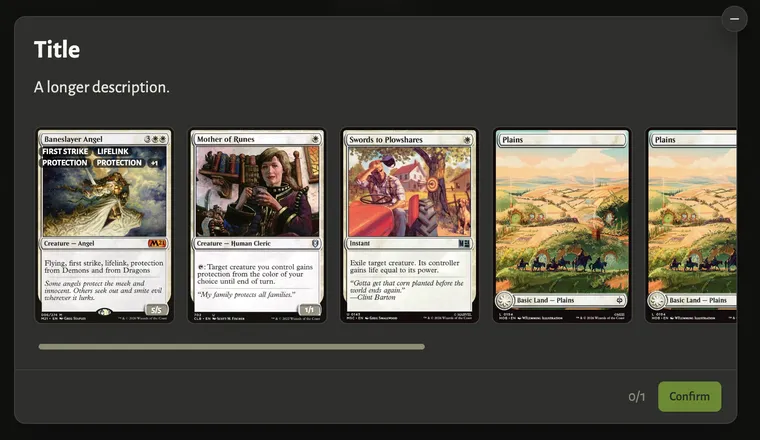
A small set lays the cards out in a single row - quick to scan and tap.
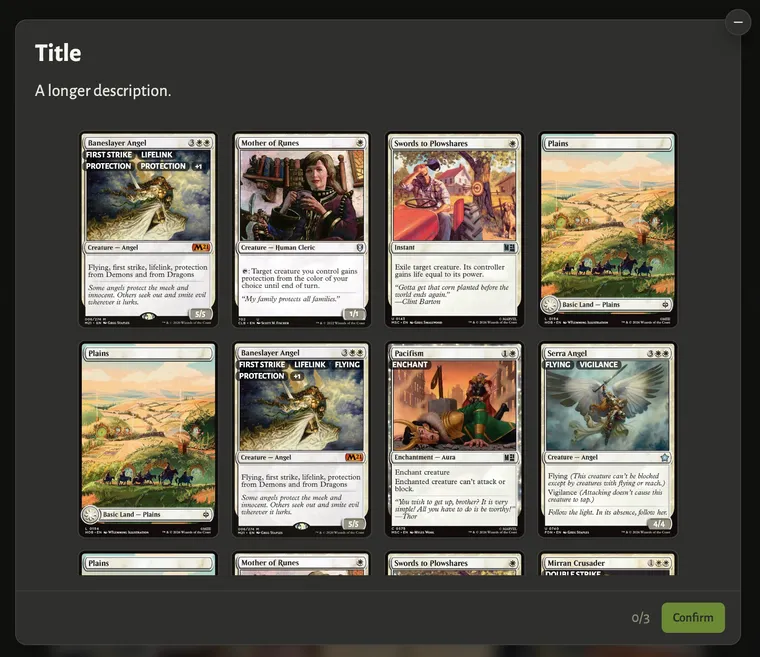
A larger set wraps into a scrollable grid, and gains a name filter once the list is long enough to need it.
Response
Section titled “Response”type ChooseCardsOutput = { type: "chooseCardsDecision"; chosenCardIds: string[] };Return the ids of the chosen cards - between min and max of them.
Example
Section titled “Example”{ "promptId": 12, "decidingPlayerId": "player-0", "input": { "type": "chooseCards", "presentation": { "title": "Discard two cards", "targets": [] }, "cards": [ { "id": "hand-0", "identity": { "name": "Lightning Bolt" }, "manaCost": "{R}", "types": ["Instant"] }, { "id": "hand-1", "identity": { "name": "Llanowar Elves" }, "manaCost": "{G}", "types": ["Creature"], "power": "1", "toughness": "1" } ], "min": 2, "max": 2 }}{ "kind": "response", "promptId": 12, "action": { "type": "chooseCards", "output": { "type": "chooseCardsDecision", "chosenCardIds": [ "hand-0", "hand-1" ] } }}